

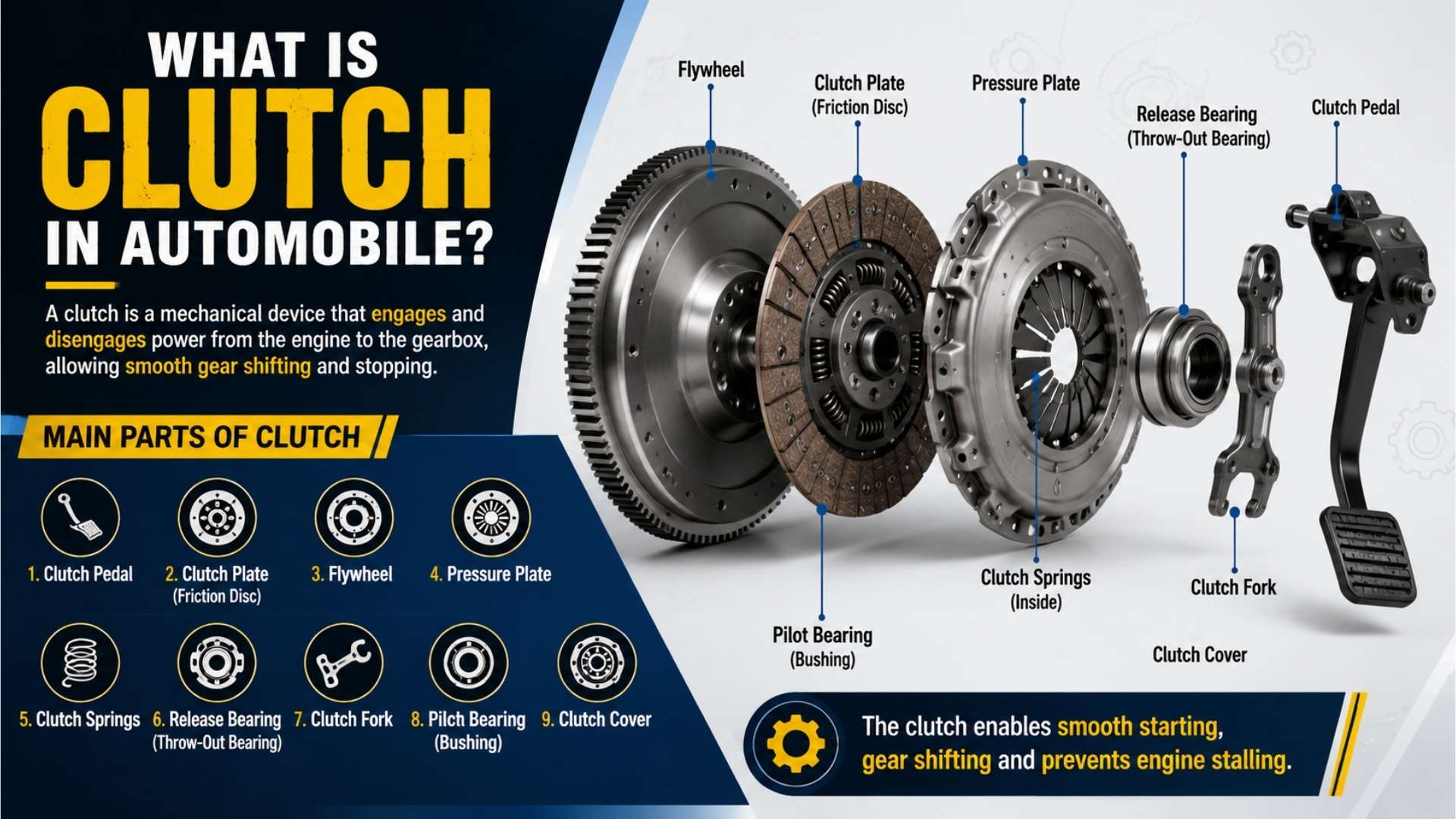
A clutch is a mechanical device used in automobiles to engage and disengage power transmission from the engine to the gearbox (transmission system). It allows the driver to change gears smoothly and stop the vehicle without turning off the engine.
In simple words, the clutch acts as a connection between the engine and transmission. When you press the clutch pedal, the connection breaks temporarily, allowing smooth gear shifting. When you release the pedal, power flows again from the engine to the wheels.
The clutch is mainly used in manual transmission vehicles such as cars, trucks, motorcycles, and heavy machinery.
Why is Clutch Used in an Automobile?
The clutch performs several important functions:
- It helps in smooth starting of the vehicle
- Enables gear shifting without damaging gears
- Temporarily disconnects the engine from wheels
- Prevents engine stalling when the vehicle stops
- Helps in smooth acceleration and deceleration
For example, when a car is stopped at a traffic signal while the engine is still running, pressing the clutch prevents the engine from stopping.
Working Principle of Clutch
The clutch works on the principle of friction.
When the clutch pedal is released, friction plates come in contact and power from the engine is transmitted to the gearbox. When the pedal is pressed, these plates separate, interrupting power transmission.
The friction between rotating parts allows smooth transfer of torque from the engine to the transmission system.
Main Parts of Clutch
The following are the major parts of a clutch system:
1. Clutch Pedal
The clutch pedal is the part operated by the driver. By pressing it, the driver disengages the clutch and interrupts engine power flow.
2. Clutch Plate (Friction Disc)
The clutch plate is mounted between the flywheel and pressure plate. It contains friction material on both sides and helps transfer engine power through friction.
3. Flywheel
The flywheel is attached to the engine crankshaft. It rotates with the engine and provides a surface for the clutch plate to make contact.
4. Pressure Plate
The pressure plate presses the clutch disc against the flywheel to transmit power. It helps engage the clutch when the pedal is released.
5. Clutch Springs
These springs provide the force required to press the pressure plate against the clutch disc. Commonly, diaphragm springs are used in modern vehicles.
6. Release Bearing (Throw-Out Bearing)
The release bearing helps disengage the clutch by pushing against the pressure plate fingers when the clutch pedal is pressed.
7. Clutch Fork
The clutch fork transfers movement from the clutch pedal mechanism to the release bearing.
8. Pilot Bearing/Bushing
It supports the transmission input shaft and helps maintain alignment between engine and gearbox components.
9. Clutch Cover
The clutch cover encloses and protects internal clutch components while holding the pressure plate assembly.
Types of Clutches Used in Automobiles
Some common types of clutches are:
- Single Plate Clutch – Mostly used in passenger cars
- Multi Plate Clutch – Used in motorcycles and racing vehicles
- Cone Clutch – Uses conical friction surfaces
- Centrifugal Clutch – Automatically engages with engine speed
- Hydraulic Clutch – Uses hydraulic fluid for operation
Conclusion
A clutch is an essential component in an automobile that connects and disconnects the engine power from the transmission system. It ensures smooth vehicle operation, proper gear shifting, and prevents engine stalling. The main parts of a clutch include the clutch plate, flywheel, pressure plate, springs, release bearing, and clutch pedal. Understanding these parts helps in better maintenance and troubleshooting of vehicle transmission systems.