
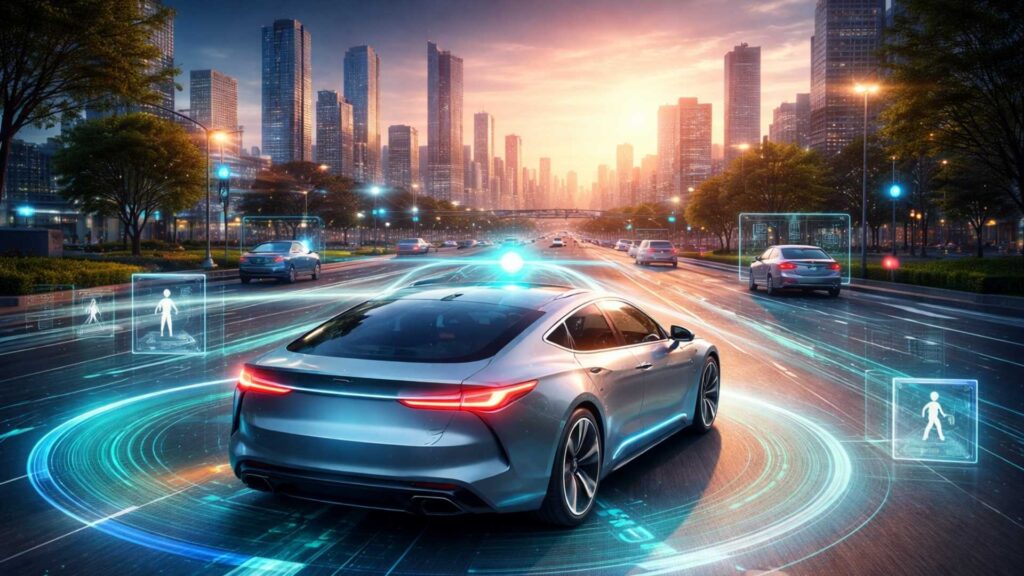
Autonomous vehicles (AVs), also called self-driving cars or driverless vehicles, are vehicles that can sense their environment and operate without human intervention.
They use a combination of sensors, artificial intelligence (AI), machine learning, cameras, radar, and LiDAR to detect surroundings, make decisions, and control steering, braking, and acceleration.
In simple terms:
An autonomous vehicle is a car that can drive itself by analyzing road conditions, traffic, and obstacles using advanced technology.
How Autonomous Vehicles Work
Autonomous vehicles operate using three main systems:
1. Perception System (Sensing the Environment)
The vehicle gathers information about its surroundings using sensors.
Common sensors include:
- Cameras – detect traffic lights, road signs, lanes
- Radar – measures distance and speed of objects
- LiDAR – creates a 3D map of surroundings
- Ultrasonic sensors – detect nearby obstacles (parking)
2. Decision System (Artificial Intelligence)
The onboard computer processes sensor data using AI algorithms to decide:
- When to accelerate
- When to brake
- How to steer
- How to avoid obstacles
It constantly predicts movements of vehicles, pedestrians, and cyclists.
3. Control System (Vehicle Actuation)
After making decisions, the system sends commands to:
- Steering system
- Braking system
- Throttle/acceleration
This allows the vehicle to physically move according to the planned path.
Levels of Vehicle Autonomy (SAE Classification)
Autonomous driving is divided into 6 levels (0–5):
| Level | Description |
| Level 0 | No automation (human driver fully controls) |
| Level 1 | Driver assistance (cruise control, lane assist) |
| Level 2 | Partial automation (car controls steering & speed but driver monitors) |
| Level 3 | Conditional automation (vehicle drives in certain conditions) |
| Level 4 | High automation (car drives itself in most environments) |
| Level 5 | Full automation (no steering wheel or human driver needed) |
Most current vehicles are Level 2, while companies are testing Level 4–5 systems.
Key Technologies Used
Autonomous vehicles rely on several advanced technologies:
- Artificial Intelligence (AI)
- Machine Learning
- Computer Vision
- Sensor Fusion
- High-definition mapping
- GPS and navigation systems
Advantages of Autonomous Vehicles
- Improved road safety (reduces human errors)
- Reduced traffic congestion
- Better fuel efficiency
- Convenience for passengers
- Accessibility for elderly and disabled people
Challenges of Autonomous Vehicles
- High development cost
- Legal and regulatory issues
- Cybersecurity risks
- Complex traffic environments
- Ethical decision-making in accidents
Examples of Autonomous Vehicle Developers
Major companies developing autonomous vehicles include:
- Tesla
- Waymo
- BMW
- Mercedes-Benz
- Toyota
- Apple
Short Summary:
An autonomous vehicle is a self-driving vehicle that uses AI, sensors, cameras, and advanced software to navigate roads and transport passengers without human control.
