
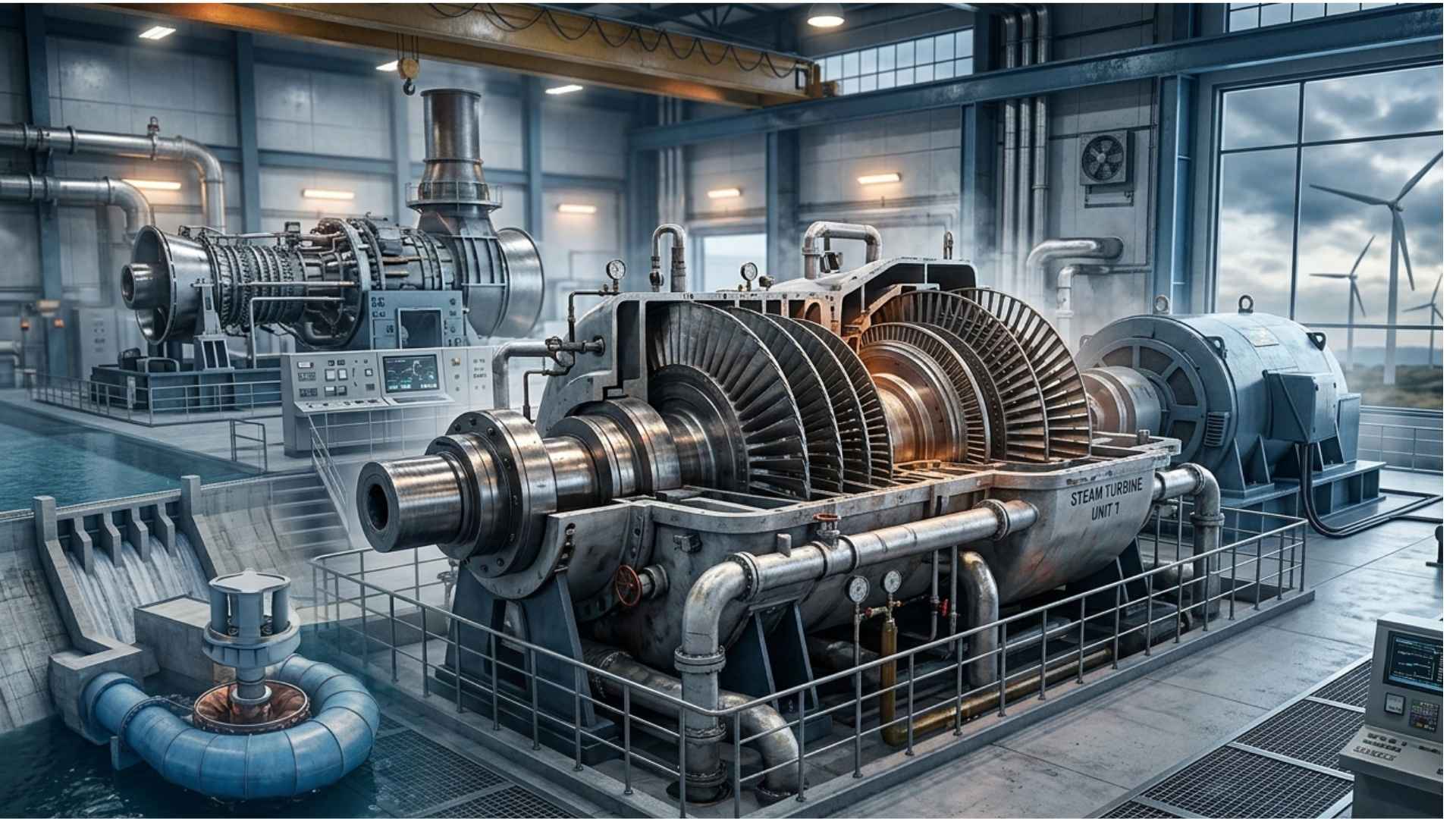
A turbine is a mechanical device that converts the energy of a moving fluid—such as water, steam, gas, or air—into rotational mechanical energy. This rotational energy is then used to drive generators, compressors, pumps, or other machinery.
Turbines are widely used in:
- Power plants
- Aircraft engines
- Hydroelectric stations
- Wind energy systems
- Marine propulsion systems
Today, turbines play a major role in modern renewable energy and industrial power generation systems.
Definition of Turbine
A turbine is a rotary machine in which the kinetic or pressure energy of a fluid is transformed into mechanical work through the rotation of blades attached to a shaft.
In simple words:
A turbine extracts energy from a moving fluid and converts it into useful rotational motion.
Working Principle of a Turbine
The basic working principle of a turbine is based on Newton’s Second Law of Motion and the conservation of momentum.
When a high-speed fluid strikes the turbine blades:
- The fluid transfers its energy to the blades.
- The blades begin rotating.
- The rotating shaft produces mechanical power.
- This mechanical power can drive an electrical generator.
The fluid used may be:
- Steam
- Water
- Air
- Combustion gases
Main Parts of a Turbine
The major components of a turbine are:
- Rotor – Rotating part connected to the shaft
- Blades/Buckets – Receive energy from the fluid
- Stator – Directs fluid flow
- Shaft – Transfers rotational power
- Casing – Outer protective cover
- Nozzle – Controls and accelerates fluid flow
Main Types of Turbines
Turbines are mainly classified according to the working fluid and operating principle.
1. Steam Turbine
A steam turbine uses high-pressure steam to rotate turbine blades.
Working
Steam produced in a boiler passes through nozzles and strikes the turbine blades, causing rotation.
Applications
- Thermal power plants
- Nuclear power plants
- Marine propulsion
Advantages
- High efficiency
- Smooth operation
- Suitable for large power generation
Disadvantages
- High installation cost
- Requires boiler system
2. Gas Turbine
A gas turbine uses high-temperature combustion gases for power generation.
Working
Compressed air mixes with fuel inside a combustion chamber. The hot gases produced expand through turbine blades and rotate the shaft.
Applications
- Aircraft engines
- Power plants
- Industrial drives
Advantages
- Compact size
- Fast startup
- High power-to-weight ratio
Disadvantages
- Lower efficiency at partial load
- Requires high-quality fuel
3. Hydraulic Turbine (Water Turbine)
A hydraulic turbine converts the energy of flowing or falling water into mechanical energy.
Working
Water strikes turbine blades and rotates the runner connected to the shaft.
Applications
- Hydroelectric power plants
- Dams
- Irrigation systems
Advantages
- Renewable energy source
- No fuel cost
- Eco-friendly
Disadvantages
- Depends on water availability
- High initial setup cost
4. Wind Turbine
A wind turbine converts wind energy into electrical energy.
Working
Wind causes the turbine blades to rotate. The rotor drives a generator to produce electricity.
Applications
- Wind farms
- Small-scale renewable systems
- Remote power generation
Advantages
- Clean energy
- Renewable source
- Low operating cost
Disadvantages
- Weather dependent
- Requires large installation area
Classification of Hydraulic Turbines
Hydraulic turbines are further divided into two major categories:
A. Impulse Turbine
In an impulse turbine, only the kinetic energy of water is used.
Example
- Pelton Wheel Turbine
Features
- Suitable for high head and low flow rate
- Water jet strikes buckets directly
B. Reaction Turbine
In a reaction turbine, both pressure and kinetic energy are utilized.
Examples
- Francis Turbine
- Kaplan Turbine
Features
- Suitable for low and medium head applications
- Operates fully submerged in water
Comparison Between Main Types of Turbines
| Turbine Type | Working Fluid | Main Use | Efficiency | Renewable |
| Steam Turbine | Steam | Thermal plants | High | No |
| Gas Turbine | Combustion gases | Aircraft, plants | Medium-High | No |
| Hydraulic Turbine | Water | Hydropower | Very High | Yes |
| Wind Turbine | Air/Wind | Renewable energy | Medium | Yes |
Real-Life Applications of Turbines
Turbines are used in almost every major power generation sector.
Industrial Applications
- Electricity generation
- Aircraft propulsion
- Oil and gas industries
- Marine engines
- Renewable energy systems
Everyday Examples
- Hydropower dams
- Wind farms
- Jet aircraft engines
- Backup power plants
Latest Trends in Turbine Technology
Modern turbine technology focuses on:
- AI-based predictive maintenance
- High-efficiency blade design
- Hydrogen-powered gas turbines
- Offshore wind turbines
- Smart monitoring systems
- 3D-printed turbine components
Renewable energy turbines are becoming more efficient and environmentally friendly.
Advantages of Turbines
- High power output
- High operating efficiency
- Reliable operation
- Suitable for continuous power generation
- Can use renewable energy sources
Disadvantages of Turbines
- High manufacturing cost
- Maintenance can be complex
- Noise and vibration issues
- Efficiency depends on operating conditions
Conclusion
A turbine is one of the most important machines used for power generation and industrial applications. It converts the energy of fluids such as steam, water, gas, or air into useful mechanical energy.
The major types of turbines include:
- Steam Turbine
- Gas Turbine
- Hydraulic Turbine
- Wind Turbine
With increasing demand for clean and efficient energy, turbine technology continues to evolve rapidly, especially in renewable energy sectors.
thanks for providing this awesome notes
ur welcome.
this was very important to know, thank you.